Product Launch Plan: The Six-Week Brief a Desk Would File
Summary
A product launch plan is a one-page document that fixes the claim, the audience, the channels and the owner for each day. Write the claim as a one-sentence lede, test it on three strangers, run six weeks in three phases, choose two channels, and track one number a person had to act on. This guide gives the full brief, with a before and after example, a week-one failure list and a day-ten review.
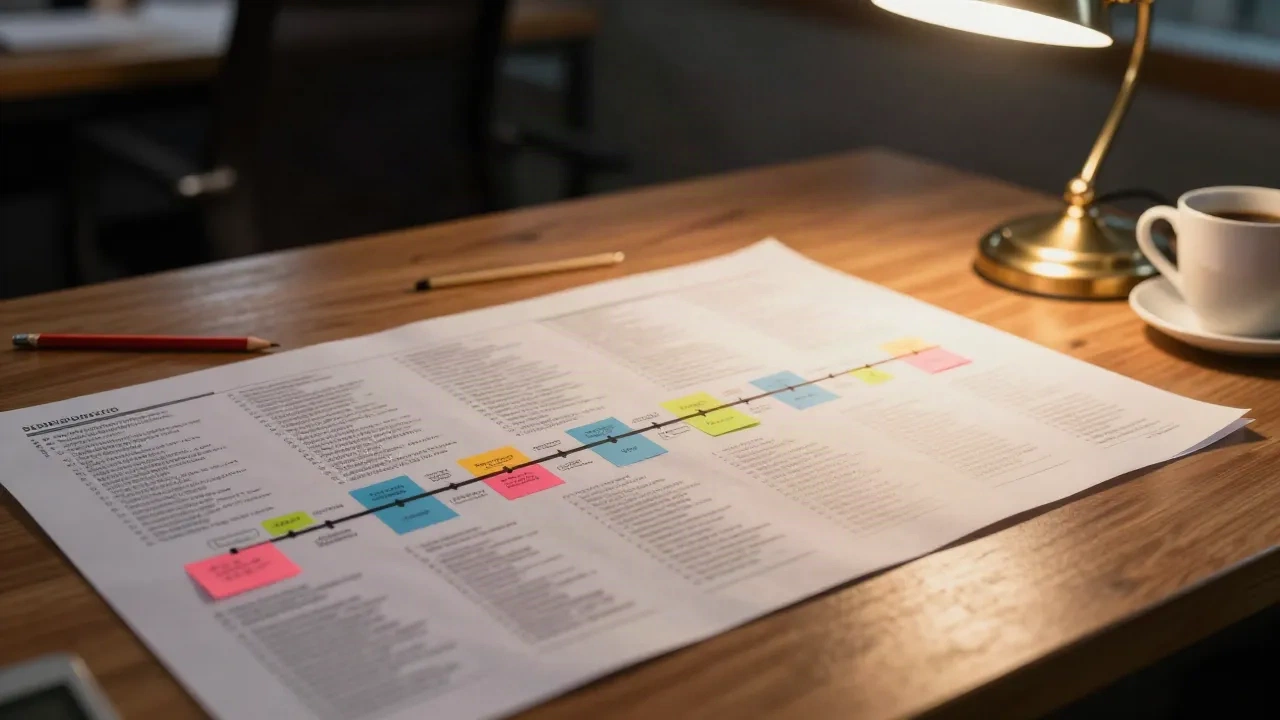
A product launch plan is the document that tells six people what to say, on which day, and who says it first. Most plans fail at the first clause. They list tasks, not messages, so on launch morning the founder, the designer and the sales lead each file a different story. Here is the plan we would file: six weeks, one claim, one owner per day.
Why most launch plans read like a project schedule
Buenos Aires, Wednesday, 11:40 pm. A founder sends me a launch plan with 94 rows. Design review, pricing page, social teasers, webinar, press list. Not one row says what the product is for.
That is the pattern. McKinsey has reported that more than half of product launches miss their business targets, and the usual diagnosis is planning and execution, not the product. A schedule is not a plan. It tells you when things happen. It does not tell you what must be true in the reader's head when they happen.
Our rule at the desk is blunt. If the plan cannot be summarised in one sentence a stranger could repeat, it is a calendar. Start there, before any tool, before any Gantt bar.
The one-sentence claim comes before the first task
Write the claim as a lede: who, what changed, why it matters now. Fifteen to twenty-five words. "Acme Ledger now closes the month in two days instead of nine, for finance teams under fifty people." That is a lede. "Acme is excited to announce a next-generation finance platform" is a press release with the news removed.
Test it on three people outside the company. Ask each to repeat it an hour later. If they return a different sentence, you do not have a claim yet, you have a mood.
Here is a before and after from a seed-stage coaching session, anonymised.
Before: "We are launching an AI-powered platform that empowers teams to collaborate more effectively."
After: "Teams of ten to fifty can now turn a customer call into a shipped ticket in under four minutes."
The second version names the buyer, the speed and the outcome. It can be checked, which means it can be believed. Everything else in the plan hangs from this sentence, and every row that cannot be traced back to it gets cut.
Six weeks, three phases, one owner per day
Nobody needs a fourteen-phase framework. Pre-launch, launch, post-launch is enough, as long as each phase has an exit condition and not just a date range. Here is the version we hand to founders.
Weeks 6 to 4, groundwork: lock the claim, the price, the proof (two customers, one number) and the list of people who must hear first.
Weeks 3 to 2, rehearsal: write every asset against the claim, then run a dry read with someone who has never heard of you.
Week 1, release: one day for the announcement, one for the direct outreach, one for the follow-up. Not seven days of "teasers".
Weeks 1 to 4 after, follow-through: answer every reply, publish the first customer result, and rewrite the claim if the market corrected you.
Notice what is missing: a separate "awareness" phase. Awareness is a result, not a task. You get it by being specific on day one, not by posting vague hints for two weeks.
Each day gets exactly one named owner. When two people own a row, nobody does. Put the name in the cell, not a team.
What to write down before launch week
The assets list is where plans balloon, so cap it. A first launch needs five documents: the claim, a one-page announcement, a short email to your list, a customer proof point and a short FAQ for the support inbox. Everything else is optional until you see traction in the numbers.
The announcement deserves the most editing. Open with the news, not the company. Put the number in the second sentence. Cut every adjective that the customer did not say first. Our copy editors have a standing habit: read the draft aloud, and strike each sentence that makes the room go quiet.
A useful discipline is to write the announcement before you build the schedule. If the announcement cannot be written, the schedule is premature. The reverse is also true: once the announcement exists, the schedule almost writes itself, because each paragraph implies an audience and a channel.
Founders ask whether a deck belongs in the launch plan. It does, but as a derivative. Your pitch narrative, your launch announcement and your sales one-pager should be the same story at three lengths. If they disagree, one of them is wrong, and it is usually the one written last at midnight.
How to run the dry read in week three
The dry read is the cheapest test in the plan, and almost nobody runs it. Send the announcement, the email and the FAQ to two people who match your buyer and have never heard of you. Give them ten minutes and one question: what does this product do, and who is it for?
Compare their answers with your claim. If both land within a few words, move on. If one says "project management" and the other says "reporting", the copy is carrying two stories, and you have just saved yourself a launch week of confusion.
Fix it by cutting, not by adding. The instinct is to explain more. The edit is to remove the sentence that opens the second story. Then run the read again with a third stranger, because the first two now know too much.
Keep a log of the exact phrases readers use to describe you. Those phrases are free copy. A buyer who says "it turns calls into tickets" has written a better headline than your team did in three meetings, and it comes with proof that real readers understand it.
Which channels earn a slot, and which get skipped
Skip the channel you cannot staff for four weeks. A launch thread you abandon on day three is worse than none, because it teaches your audience that you stop answering.
Pick two channels where your buyer already pays attention and treat them like beats. One is usually owned: your email list or your site. One is usually earned: a newsletter, a podcast, a reporter who covered your category in the last ninety days. Read what that person filed. Pitch the angle they would file next, not the one they already did.
Paid is a late decision. Spend only after you have a claim that converts organically, even at small volume. Money amplifies a message, good or bad, and it does so at a rate you will notice on the invoice.
Press lists deserve a word. Forty names you have read beat four hundred scraped from a database. Open each note with something specific from their last piece, then give the news in two sentences, then the proof. Attach nothing. Offer the embargoed detail, and do not pad the note with a biography.
There is a quieter channel that founders skip: the people who already said yes. Your first ten customers, beta users and advisors should hear the news before the public does, with one small, specific request, such as a quote, an introduction or a reply to the email. Those replies become your proof on launch day. They also catch the error in your claim while it is still cheap to fix.
A measurable target, set on Monday
Pick one number that tells you whether the claim landed. Not "reach". Something a person had to do: demos booked, trials started, replies received. Set a floor and a stretch in week six, write them in the plan, and look at them on day three after release.
Be careful with vanity counts. Impressions flatter. A hundred replies from the right fifty people beat ten thousand views from strangers. If the plan lists impressions as its headline metric, the plan is hedging.
Then schedule the post-mortem before launch day, not after. Put thirty minutes on the calendar for day ten, with one question: which sentence did customers repeat back to us, and which did they ignore? That answer feeds the next claim.

What goes wrong in week one, and the fix
Three failures repeat. First, the claim drifts: marketing shortens it, sales stretches it, the founder improvises on a podcast. Fix: one pinned document, and one person allowed to edit it.
Second, the follow-through dies. The announcement goes out Tuesday and by Friday nobody has answered the replies. Fix: block two hours each morning of launch week for replies only. Nothing else goes in that slot.
Third, the plan ignores the product's real weak spot. Every launch has one, and your first customers will find it within hours. Fix: write the honest answer to the hardest question in the FAQ before you ship. Customers forgive a stated limit. They do not forgive a surprise.
What we would file, and what we would skip
If you have one hour, do this. Write the claim. Test it on three strangers. Cut the task list to five assets and two channels. Name one owner per day. Set one number. Book the day-ten review.
Skip the teaser campaign unless you have an audience that already waits for you. Skip the launch event if the product does not need a room. Skip the 94-row sheet; a one-page plan that people read beats a sheet that people sort.
Founders who follow this do not launch louder. They launch clearer, and clarity is what a reader remembers on Thursday, when the noise has moved on.
Filed. Buenos Aires, 23 h 52.